
If your home was built before 1980 and still has its original textured ceiling finish — the bumpy, rough-surfaced treatment commonly called a popcorn ceiling, acoustic ceiling, or cottage cheese ceiling — there’s a meaningful chance it contains asbestos. For many homeowners, that’s an unsettling thing to discover, and questions follow quickly: What exactly is asbestos? Why was it put in ceilings in the first place? Is it dangerous? And what should you do about it?
This post addresses the first part of that conversation: what asbestos is, why it was so widely used in construction materials, and specifically how and why it ended up in the sprayed ceiling finishes that covered millions of American homes from the 1950s through the late 1970s.
Asbestos is not a single material — it’s a category of naturally occurring silicate minerals characterized by their fibrous crystal structure. Six mineral types fall under the asbestos classification, but three were most commercially significant: chrysotile (white asbestos), amosite (brown asbestos), and crocidolite (blue asbestos). Chrysotile accounted for the vast majority of asbestos used in construction and manufacturing applications.
What all asbestos minerals share is a distinctive physical structure: they occur as long, thin microscopic fibers that can be separated and processed into a material with a remarkable combination of properties. Those properties are what made asbestos so extraordinarily useful — and so dangerously widespread — throughout the twentieth century.
Understanding why asbestos was used so broadly in construction requires appreciating what an exceptional material it appeared to be before its health hazards were understood and acknowledged.
Heat and fire resistance. Asbestos fibers are virtually non-combustible and remain stable at temperatures that destroy most organic materials. This made asbestos-containing products invaluable as insulation in high-heat applications — around boilers, pipes, furnaces, and anywhere fire resistance was needed. In the construction industry, incorporating asbestos into building materials provided passive fire protection that was genuinely difficult to achieve with alternative materials at the time.
Tensile strength. Despite being a mineral fiber, asbestos has remarkable tensile strength — comparable in some respects to steel on a fiber-by-fiber basis. Asbestos fibers could be woven, spun, mixed into composites, and added to other materials to dramatically increase their structural integrity. Asbestos cement, asbestos-reinforced plaster, and asbestos-containing floor tiles were all more durable than their fiber-free equivalents.
Chemical inertness. Asbestos fibers are highly resistant to chemical attack — they don’t degrade in the presence of most acids, alkalis, or solvents. This made asbestos-containing materials durable and long-lasting in applications where chemical exposure was a concern.
Electrical insulation. Asbestos is a poor conductor of electricity, making it useful in electrical insulation applications throughout the early and mid-twentieth century.
Abundance and low cost. Asbestos minerals were mined in enormous quantities — primarily in Canada, Russia, and South Africa — and were available at very low cost. Adding asbestos to a building product improved its performance significantly without meaningfully increasing its price. For manufacturers competing in price-sensitive construction markets, asbestos was effectively a performance upgrade that cost almost nothing.
Easy processing and compatibility. Asbestos fibers could be mixed into an enormous variety of materials — cement, plaster, vinyl, textile, paper, paint — without complicated processing. They bonded well with binding agents, didn’t require special equipment to incorporate, and were stable in mixed formulations.
The combination of these properties made asbestos genuinely extraordinary by the standards of the mid-twentieth century construction industry. It was used in floor tiles, roof shingles, pipe insulation, fireproofing sprays, joint compound, ceiling tiles, siding, and hundreds of other products. At its peak in the 1970s, the United States was consuming several hundred thousand metric tons of asbestos annually.
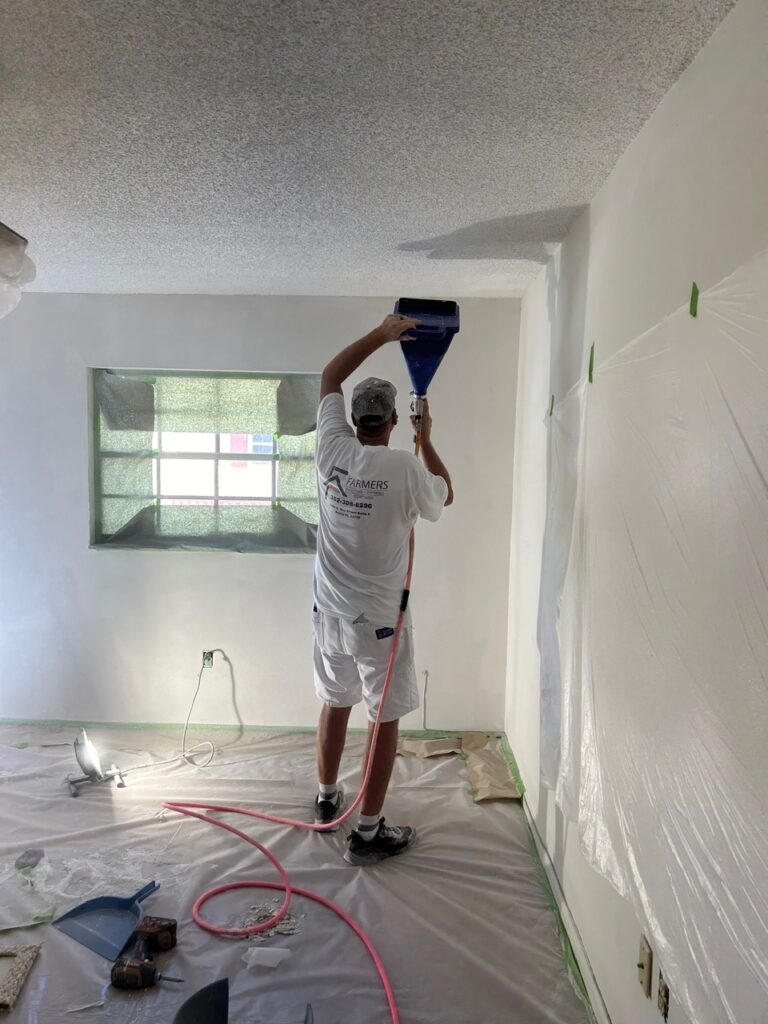
Popcorn ceiling texture — the rough, bumpy spray-applied finish that became the standard residential ceiling treatment from roughly the 1950s through the 1970s — was itself a product of the same era that embraced asbestos widely in construction.
The texture was applied as a spray mixture of binders, water, and texture-creating aggregates, then left to dry into its characteristic rough surface. Asbestos fibers were added to that mixture for several reasons.
Acoustic dampening. The primary marketed benefit of acoustic ceiling texture was its ability to reduce sound transmission and echo within rooms. Asbestos fibers, mixed into the spray compound, contributed to the material’s sound-absorbing properties by creating a porous, irregular surface structure. This is where the name “acoustic ceiling” originated and why the product was aggressively marketed to homeowners and builders seeking quieter interior spaces.
Fire resistance. Adding asbestos fibers to the ceiling spray compound improved its fire resistance rating — a selling point for builders and a genuine performance characteristic at a time when building codes were increasingly focused on passive fire protection in residential construction.
Structural reinforcement. Asbestos fibers helped bind the texture compound together and added tensile strength to the dried finish, reducing the likelihood of the texture cracking, flaking, or separating from the ceiling substrate over time.
Low cost and wide availability. As with virtually every other asbestos application, the addition of asbestos fibers to ceiling texture compounds was essentially free from a manufacturing cost standpoint. It improved the product’s marketed performance characteristics without adding meaningful expense.
The result was a ceiling finish that checked multiple boxes simultaneously — attractive by mid-century standards, acoustically beneficial, fire-resistant, durable, and cheap to manufacture and apply. Popcorn ceiling texture became enormously popular in residential construction, particularly in tract housing and multi-family construction where speed, economy, and basic acoustic performance were all priorities.
The use of asbestos in spray-applied ceiling textures was effectively ended by regulatory action in the United States. The Environmental Protection Agency banned asbestos in spray-applied surfacing materials in 1973, with a more comprehensive expansion of restrictions following in subsequent years. By the late 1970s, asbestos was largely eliminated from new residential ceiling texture products, though some manufacturers continued using it until regulatory enforcement made it untenable.
This regulatory timeline is why the 1980 construction date is commonly used as the dividing line in practical guidance: homes built after 1980 are unlikely to have asbestos-containing popcorn ceilings because the material was no longer legally used in spray-applied surfacing by that point. Homes built or significantly renovated between 1950 and 1980, however, may have original ceiling texture that contains asbestos — and some homes built in the early 1980s may contain ceiling texture applied from product stock manufactured before the ban took full effect.
It’s also important to understand that not every popcorn ceiling from this era contains asbestos. Manufacturers used different formulations, and some products from the same period used non-asbestos aggregates such as polystyrene or vermiculite. The only way to determine with certainty whether a specific ceiling contains asbestos is laboratory testing of a collected sample.
The properties that made asbestos so commercially valuable — particularly its fibrous structure and its extraordinary durability — are also what makes it dangerous to human health.
When asbestos-containing materials are disturbed, cut, sanded, drilled, or degraded, the microscopic fibers are released into the air and can be inhaled. Because the fibers are extremely small and their shape allows them to penetrate deep into the respiratory system, the body is largely unable to expel them once inhaled. The fibers embed in lung tissue and the lining of the chest cavity (the pleura), where they cause chronic inflammation that, over years and decades, can lead to serious and often fatal diseases.
The asbestos-related diseases of primary concern are:
These diseases have latency periods that typically range from 20 to 50 years between initial exposure and disease onset, which is one reason the health effects of widespread asbestos use weren’t fully apparent until decades after peak usage. By the time the occupational and public health consequences were undeniable, asbestos had already been incorporated into tens of millions of buildings across North America and beyond.
For homeowners living with potentially asbestos-containing popcorn ceilings, the most important concept to understand is the distinction between intact and disturbed asbestos-containing material.
Asbestos that is in good condition and left undisturbed does not pose a significant health risk. The fibers remain bound within the material and are not released into the air in meaningful quantities. A popcorn ceiling that is intact, firmly adhered, and showing no signs of deterioration can often be left in place safely without immediate action.
The risk arises when the material is disturbed — and the most common scenario in which homeowners inadvertently expose themselves and their families to asbestos is during renovation work. Sanding, scraping, or removing a popcorn ceiling without first testing for asbestos and following proper abatement procedures can release enormous quantities of airborne asbestos fibers into the living space. This is a serious hazard that has caused real harm to homeowners who proceeded without awareness of what their ceilings contained.
Before any renovation work that would disturb a pre-1980 popcorn ceiling — or any other ceiling texture, joint compound, floor tile, or insulation from that era — testing is the essential first step. Asbestos testing kits are available for homeowner sampling, and certified laboratories can analyze samples and return results within days. For higher-stakes situations or when the area of concern is large, hiring a certified asbestos inspector to collect samples professionally provides additional assurance and a documented chain of custody.
That question deserves its own full discussion, but the short answer is:
Asbestos was used in popcorn ceilings because it made them genuinely better by mid-century standards — more acoustically effective, more fire-resistant, more durable, and nearly free to add. The harm it caused was invisible at the time of application, unfolding over decades in the form of diseases that appeared long after the decisions to use it had been made and forgotten.
For homeowners today, the legacy of that era is a practical reality to be managed thoughtfully rather than panicked over. Asbestos in a popcorn ceiling is not an emergency if the material is intact — it is a known condition that informs how you approach any future work on that surface. Understanding what it is, why it’s there, and how to handle it responsibly is the starting point for making sound decisions about the home you’re living in.